Inside HeyRik: One Studio for Voice Agents That Take Real Calls
How we shaped HeyRik into a single place to build, launch, and measure lifelike phone agents — instead of stitching five vendors together and hoping.

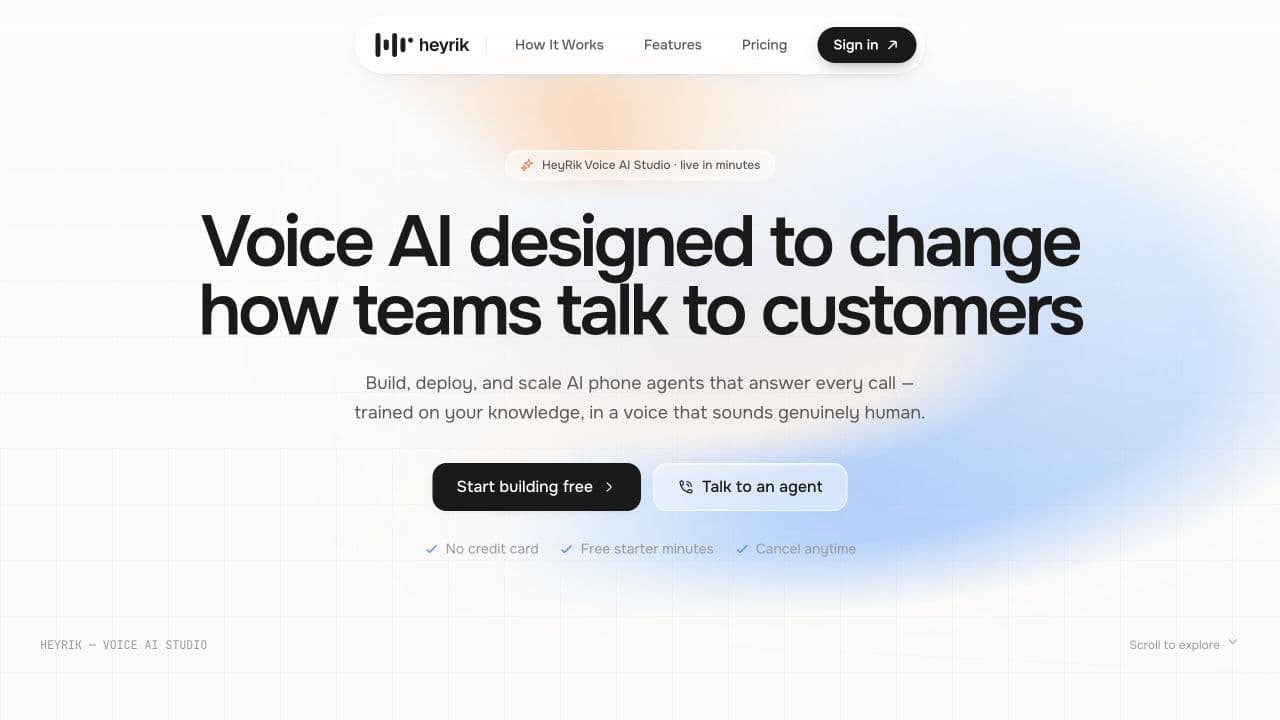
The phone never went away. It just stopped getting attention. Most teams still route their highest-intent conversations — inbound leads, service calls, appointment changes — through tools that do not talk to each other: a phone menu from one vendor, a dialer from another, recordings somewhere else, and a spreadsheet holding the whole thing together. HeyRik was built to collapse that. One place to build a voice agent, give it a number and a brain, put it on live calls, and learn from every one of them.
One studio instead of five integrations
The core product decision was to stop treating a voice agent as a prompt bolted onto a phone number. Launching one means shaping the call flow, picking a voice, connecting the knowledge the agent is allowed to use, managing inbound and outbound traffic, and reviewing what happened afterward. Those are five different jobs, and most stacks make you buy five different products to do them. HeyRik puts them on one surface, so the path from idea to a working agent is an afternoon rather than an integration project.
- Low-latency voices tuned for interruptions, backchannels, and natural turn-taking
- A visual builder for prompts, call flows, and branching logic — no code required
- Answers grounded in the business’s own documents, pricing, and policies
- Bring your own number, or connect through Twilio, Exotel, or SIP trunking
- Outbound campaigns with scheduling, retries, and live monitoring
- Recordings, transcripts, call scoring, and operational analytics on every conversation
Built around how people actually talk
Voice is unforgiving in a way chat never is. A pause that would be invisible in a text box sounds like a dropped call. An agent that keeps talking over the caller reads as rude, not efficient. A hedge in the wrong place costs the sale. So the product is designed conversation-first: short answers, speech that starts before the full response exists, clean barge-in, honest fallbacks, and a warm handoff to a person the moment the agent hits its limit.
One platform, many jobs
The same core supports an after-hours receptionist for a dental office, lead qualification for a mortgage broker, appointment reminders for a clinic, first-line support for a software team, and outbound follow-up at volume. Rather than hard-coding one narrow use case, HeyRik hands each business the controls: the voice, the knowledge, the flow, and the rules for when a human takes over.
Control, not a black box
Teams define what the agent knows, what it is allowed to do, when it must transfer, and how a call gets scored. That is what makes a voice agent usable in production, where brand consistency and recoverability matter more than a demo that impresses a room.
Every call feeds the next one
A call should not evaporate when someone hangs up. Transcripts, outcomes, recordings, and scores form a loop: you can see which questions the agent fumbled, which knowledge gaps keep resurfacing, which objection shows up on every third call, and which step in the flow quietly loses people. The agent improves because the product makes those signals hard to ignore.
“HeyRik turns voice AI from a one-off integration into a product a team can launch on Monday and keep sharpening every week after.”
Where it lands
Underneath, HeyRik is real-time speech infrastructure. On the surface, it is a calm product a non-engineer can operate. That combination is the point: answer every call, follow up at a scale a human team cannot match, and keep people in charge of the conversations where being human is the entire value.