Why Most AI Copilots Demo Well and Ship Badly
The gap between a copilot that wows a room and one people use every Tuesday is not the model. It is scope, grounding, recovery, and measurement.

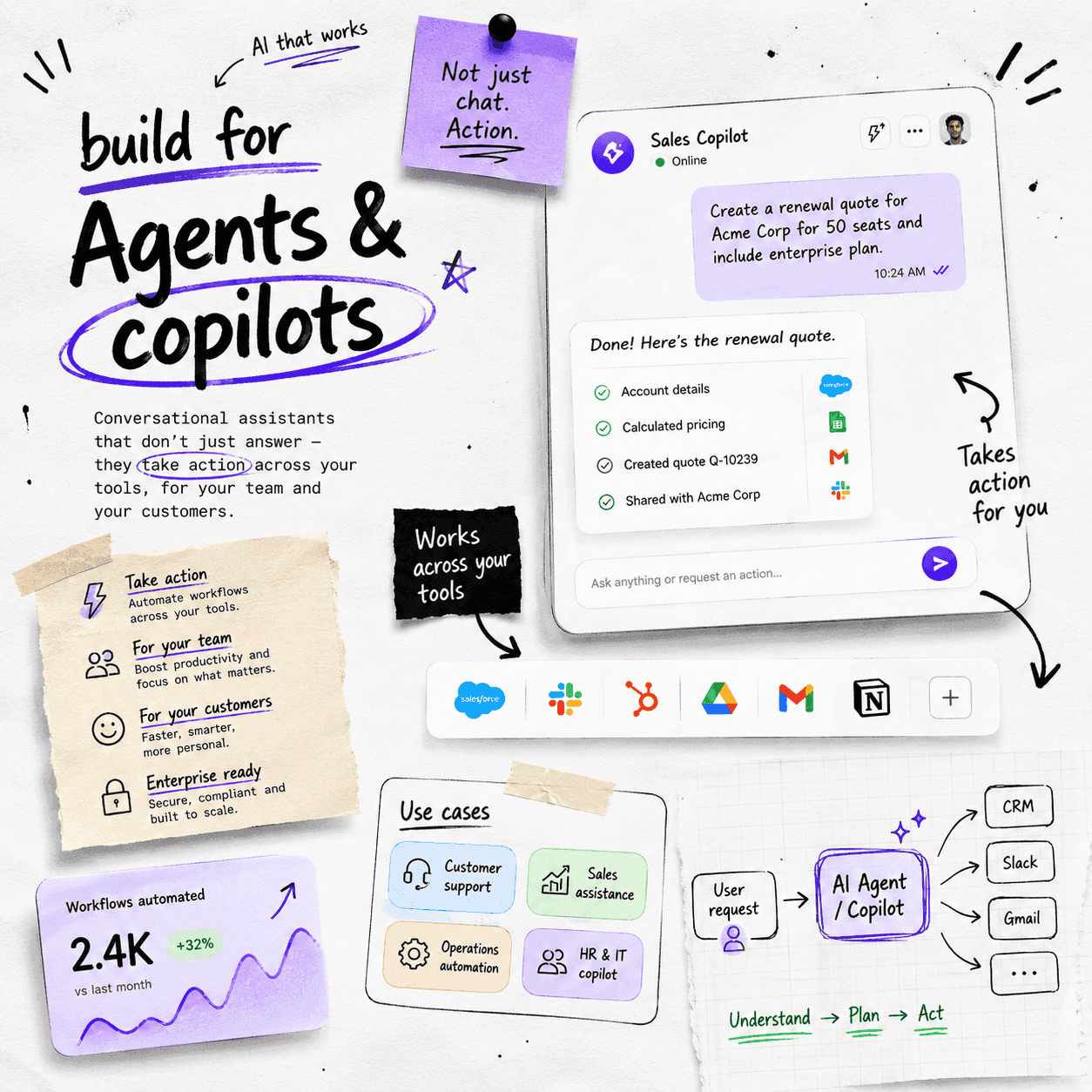
Every copilot demos beautifully. Five minutes, three questions the presenter already knew the answers to, a room full of nodding. The trouble starts in week three, when someone asks a question nobody rehearsed and the copilot answers with total confidence and no basis. What separates the demo from the product is not the model. It is the system built around it.
Narrow it until it becomes useful
The first failure is ambition. A copilot that answers anything about the whole company ends up subtly wrong in a hundred places, and subtle wrongness is worse than silence — it costs users the ability to trust anything the system says. The copilots that survive are small: one workflow, one domain, deep knowledge inside the fence and an honest refusal outside it. Narrow scope is not a compromise. It is the precondition for trust.
Ship a job, not a chat box
“A chatbot in the dashboard” has no success state. “Draft the reply to this ticket,” “explain this line on the invoice,” and “find the clause that covers refunds” all do. Tie the copilot to a job and you get something you can evaluate, price, and improve. Tie it to a surface and you get a feature nobody can prove is working.
Ground every single claim
Trust comes from traceability. Every statement the copilot makes should point back to something you handed it, not to whatever the model absorbed in training. Retrieval, inline citations, and a hard rule that the model answers only from provided context turn a confident guesser into a colleague. Users forgive a miss they can spot. They do not forgive one they cannot.
- Retrieve context first, then generate — never let the model write and find sources afterward
- Put citations inline so any claim is one click from its source
- Treat “I could not find that” as a designed response, not an error path
- Log the retrieved context alongside every answer so failures are debuggable next week
Design for being wrong
A non-deterministic system will be wrong. That is a property, not a defect to engineer away. The real design question is what a wrong answer costs. Make correction one click. Make undo obvious. Put a person in front of anything expensive or irreversible. The copilots that stay in a workflow are not the flawless ones — they are the ones where being wrong is cheap.
“Users do not need a copilot that is always right. They need one that is honest about what it knows and easy to correct when it is not.”
Instrument it like a service
Nobody runs a payments API without dashboards. A copilot deserves the same treatment. Build an eval set from real questions with known-good answers, run it on every prompt and model change, and track accuracy, grounding rate, escalation rate, and cost per answer side by side. “It feels better” is not a metric — it is a memory of the last three examples somebody tried.
The boring work is the product
Scope discipline, retrieval quality, recovery paths, and evals make the least interesting slides in any deck and the entire reason a copilot survives contact with users. That is the work we insist on at Zehnai before an AI feature goes anywhere near production traffic.